
Electric vehicle charging in Bexley
Bexley Council is currently looking at a range of options and providers for the installation of Electric Vehicle Charge Points across the borough on the public highway.
The Council proposes to utilise available Government funding to support the delivery of electric vehicle charging infrastructure. Funding has been secured through the LEVI programme, and the project is currently progressing through the implementation and governance stages.
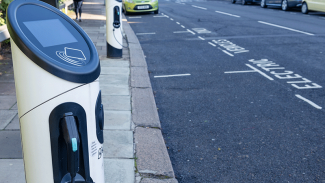
Public charging
There are many publicly accessible charge points in car parks and retail outlets.
We have provided AC charge points on the public highway at locations such as:
| Road | Area | Postcode |
|---|---|---|
| Sandford Road | Christchurch | DA7 4ER |
| The Park | Sidcup | DA14 6AL |
| Picardy St | Belvedere | DA17 5PZ |
| Upper Abbey Road | Belvedere | DA17 5AQ |
| Picardy Road | Belvedere | DA17 6LH |
| The Crescent | Sidcup | DA14 6NU |
| Maiden Lane | Crayford | DA1 4FQ |
| Reddy Road | Erith | DA8 2AY |
| Woodside Road | Sidcup | DA15 7JQ |
| Albany Park Car Park | Bexley | DA5 3HP |
| Mill Road Car Park | Erith | DA8 3HB |
| Nuxley Road Car Park | Belvedere | DA17 5LJ |
| Thanet Road Car Park | Bexley | DA5 1AP |
| Westwood Lane Car Park | Welling | DA16 3QS |
| Avenue Road Car Park | Bexleyheath | DA7 4EH |
Ubitricity is our delivery partner for on-street electric vehicle charging, providing integrated charge points within existing street infrastructure such as lamp posts and bollards. This offers a low-cost, near-home charging solution for residents who do not have access to private off-street parking and supports overnight and residential charging across the borough.
In partnership with Ubitricity, we have installed over 400 lamp-column EV chargers and continue to expand charging provision where demand exists. These installations form a key part of the Council’s wider EV infrastructure programme, enabling more residents to charge conveniently and supporting the transition to zero-emission transport.

Home charging and the public highway
The Council recognises the importance of enabling residents to charge electric vehicles at home wherever possible. However, where properties do not have off-street parking, the use of domestic charging equipment must be balanced against the Council’s statutory duties to protect the safety, accessibility, and integrity of the public highway.
Under the Highways Act 1980, the Council has a duty to ensure that the public highway is maintained in a safe condition and kept free from obstructions. The placing of loose or trailing charging cables across footways, even on a temporary basis, can constitute an obstruction of the highway and may present significant risks to pedestrians, wheelchair users, those with visual impairments, and other vulnerable road users.
For these reasons, the Council does not support or permit ad-hoc arrangements where charging cables are run across pavements without an approved, engineered solution. Such arrangements increase the risk of trips and falls, create accessibility barriers, and expose residents and the Council to potential liability.
Cross-Pavement EV Charging
The Government’s guidance on cross-pavement electric vehicle charging supports local authorities in enabling residents without off-street parking to charge electric vehicles safely from their home electricity supply, without compromising highway safety or accessibility.
Council-approved cross-pavement solutions -such as recessed, in-footway cable channels (often referred to as gullies) - allow charging cables to pass beneath the pavement surface, eliminating trip hazards and ensuring the footway remains unobstructed. These solutions are designed to comply with:
- The Highways Act 1980
- The Council’s duty under the Equality Act 2010 to maintain accessible routes
- Relevant IET safety guidance on EV charging infrastructure
- Highway construction and maintenance standards
Compared to temporary cable mats, ramps, or exposed leads, CPO-installed cross-pavement systems provide a safer, more durable, and enforceable solution, ensuring consistent standards across the borough and reducing long-term maintenance and liability risks.
In line with national guidance, the Council is progressing cross-pavement EV charging as part of its wider EV infrastructure strategy. The Council is currently in the process of appointing approved Charge Point Operators (CPOs) to deliver these solutions within the borough, supported by government funding streams intended to help reduce installation costs for eligible residents.
Once appointed, only CPO-approved solutions installed under a formal agreement with the Council will be permitted on the public highway. Further details, including application processes, eligibility criteria, and links to approved providers, will be published once contractual arrangements are finalised.
Approved provider links:
How to find charge points
There are some online resources which map out where charging points are available:
Charging between charge points near the kerb and Electric Vehicles is permitted and must be part of the driver's insurance cover in the event of any trips caused.
Residential on-street EV charging hubs
Bexley Council is expanding access to electric vehicle charging for residents who do not have off-street parking through the installation of residential on-street EV charging hubs, delivered in partnership with Trojan Energy.
These charging hubs are designed specifically for residential streets, allowing residents to charge their vehicles close to home without the need for driveways or dedicated parking bays. When not in use, the chargers sit flush within the pavement, helping to minimise street clutter and maintain clear, accessible footways.
Residents use their own personal charging adaptor to connect to the hub and charge their vehicle, providing a safe, convenient and reliable charging option that integrates into everyday parking patterns.
Benefits for residents and the borough
- supports residents without off-street parking to switch to electric vehicles
- helps keep pavements clear and accessible for pedestrians, wheelchair users and people with pushchairs
- each Hub delivers multiple charge points, maximising capacity on residential streets
- contributes to improved air quality and the borough’s wider sustainability and transport objectives
Residential charging hubs are being rolled out across a number of streets in the borough, with locations selected based on resident demand and suitability of the street environment.