
Highways Maintenance Spending Figures
| Year | Capital allocated by DfT (£,000s) | Capital spend (£,000s) | Revenue spend (£,000s) | Estimate of % spent on preventative maintenance | Estimate of % spent on reactive maintenance |
|---|---|---|---|---|---|
| 2025 to 2026 (projected) | £895 | £4,510 | £1,936 | 61% | 39% |
| 2024 to 2025 | £275 | £3,281 | £1,380 | 66% | 34% |
| 2023 to 2024 | £275 | £4,218 | £1,411 | 71% | 29% |
| 2022 to 2023 | £ nil | £2,871 | £1,119 | 72% | 28% |
| 2021 to 2022 | £ nil | £2,440 | £1,882 | 56% | 44% |
| 2020 to 2021 | £ nil | £1,507 | £2,827 | 35% | 65% |
See terminology notes below for explanations for these column headings.
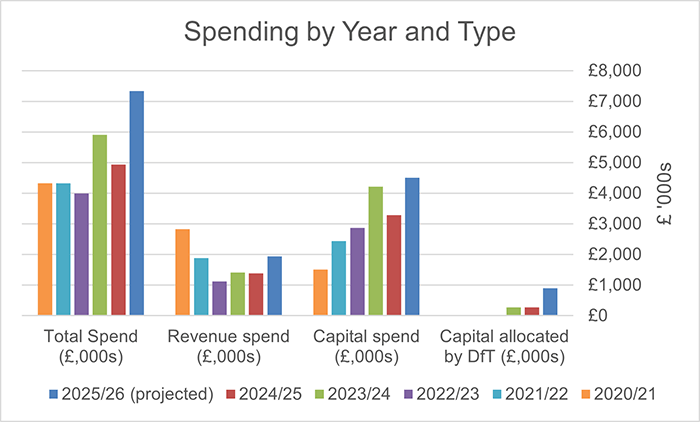
It can be seen that the allocation of spend in recent years is around two thirds towards preventative maintenance and one third reactive maintenance. Preventative maintenance is often focussed on larger projects, such as full resurfacing, and so costs will be higher with this work treating high numbers of defects per location and before they become big enough to warrant reactive and urgent repairs. Reactive maintenance treats items once they have already occurred, such as filling in potholes, and lower in cost but greater in number of locations.
2020 to 2021 was the start of the Covid-19 pandemic lockdown restrictions, which resulted in reduced expenditure in planned resurfacing works, with a consequent increase in revenue expenditure to deal with road defects when necessary to maintain a safe road network.
Additional information on spending
Bexley maintains its highway network using both preventative and reactive maintenance approaches.
Terminology notes
Resurfacing
The term “resurfacing” is commonly used to describe any replacement of a road’s surface, regardless of how deep the layers go. However, the Department for Transport (DfT) defines “resurfacing” as only the replacement of the top 50mm or less of the road surface. Any replacement work involving more than 50mm in depth is classed as “strengthening”.
In Bexley, we typically replace road surfaces (in roads that are built up in multiple layers of asphalt material) to a depth of at least 90mm. By the DfT definition, this depth of work should be considered ‘strengthening’. This deeper treatment is expected to last significantly longer, reducing the need for repeated repairs and making the process more cost-effective, as the required machinery and workforce are already on site.
However, for the purpose of this report and to aid public understanding, we use the term “resurfacing” to describe this surface replacement work.
Carriageway
This is the part of a road / street that takes the vehicular traffic. Road and Carriageway are commonly used to represent this same part of the public highway. This is made up of layers of asphalt, thick concrete, or both.
Footway
This is the area for pedestrians, normally on both sides of the carriageway. These are generally made up of concrete stone slabs or asphalt.
Capital funding
In accordance with national legislation, this funding may be used for the construction or improvement of fixed assets, like roads, that will be used for a notable period of time. This is used for works such as resurfacing and larger patches of surfacing.
Revenue funding
In accordance with national legislation, this funding covers day-to-day running costs of services such as routine maintenance. This is used for small repairs such as pothole treatments.
Preventative maintenance
This approach involves treating roads before major defects appear. It includes patching or resurfacing large areas or long sections of carriageways and footways to extend the life of the surface and reduce the likelihood of future problems.
While this may involve removing some road material that is still in usable condition, the benefits outweigh the waste by addressing surrounding or early-stage issues in one go.
These works are primarily funded by Bexley’s Capital budget and may also be supported by other sources, such as the DfT’s highway maintenance grants. Capital funding is used when a project can replace or significantly extend the life of the infrastructure, making it suitable for large patching and resurfacing works.
Reactive maintenance
Reactive maintenance is used to fix defects such as potholes that have already formed. This approach focuses on small, localised areas and is generally quicker and less costly. However, it only addresses issues after they become large enough to require intervention.
Reactive works are funded entirely from Bexley’s Revenue budget, which is intended for minor and routine repairs, such as individual potholes. This funding is also used to address other highway defects, such as trip hazards and uneven footway paving.
Potholes
Potholes are one of several types of defects found on road surfaces. They are commonly seen as small holes that develop when a road surface begins to deteriorate or has not been constructed to a suitable standard.
They typically form when water enters cracks or gaps in the surface or between layers of asphalt. These gaps can appear due to the age of the road, movement in the surface, nearby excavation work or joints, or even underlying poor ground conditions such as high- water tables or marshy soils.
In colder weather, this water freezes and expands, widening the cracks or lifting the surface. When the ice thaws, the surface weakens under the pressure of traffic. As this freeze-thaw cycle repeats, the cracks grow until traffic breaks pieces away from the surface eventually forming a pothole.