
Condition of Local Roads
Historically, road condition assessments on classified local roads in England were all carried out using SCANNER (Surface Condition Assessment for the National Network of Roads), a laser based technology. However, Bexley along with many other local authorities has adopted newer and more advanced technologies to assess road conditions.
The SCANNER system generates a Road Condition Indicator, which classifies roads into three categories:
- Green – No further investigation or maintenance required
- Amber – Maintenance may be required in the near future
- Red – Road condition is poor and should be considered for maintenance
From 2026 to 2027, the Department for Transport (DfT) is expected to require all Local Highway Authorities to report road conditions using a new standard (BSI PAS 2161 standard). This change will allow for a more consistent and detailed comparison of road condition data across the country, and looks to categorise road condition into 5 categories instead of the 3 under Red/Amber/Green method.
The new standard is to introduces categories under the following descriptions:
- No Deterioration – No maintenance required
- Minor (or aesthetic) Deterioration – Minor maintenance such as small patching
- Moderate Deterioration – Localised or mid-life maintenance, including surface dressing, patching, or crack sealing
- Moderate to Severe Deterioration – Rehabilitative maintenance such as thin resurfacing, multiple patching, or edge repairs
- Severe Deterioration – Structural maintenance, such as full resurfacing or reconstruction
Bexley’s current assessment method already follows a 5 category method and so better aligns with the upcoming new standard.
To maintain compatibility with the existing SCANNER Red/Amber/Green (RAG) system required by the DfT, Bexley and the DfT have agreed that we can map the 5 categories of condition to the RAG system as follows:
- Green = Category 1 or 2
- Amber = Category 3 or 4
- Red = Category 5
In Bexley, road defects including potholes are assessed according to the Council’s adopted maintenance policy, which aligns with the national Well-managed Highway Infrastructure: Code of Practice. All roads are manually inspected at least twice a year, with areas with high pedestrian activity, such as town centres and shopping areas, inspected more frequently.
Additionally, each road undergoes a vehicle-based camera inspection at least once a year to help verify condition data.
Further information about Bexley’s inspection procedures is available on the Council’s website.
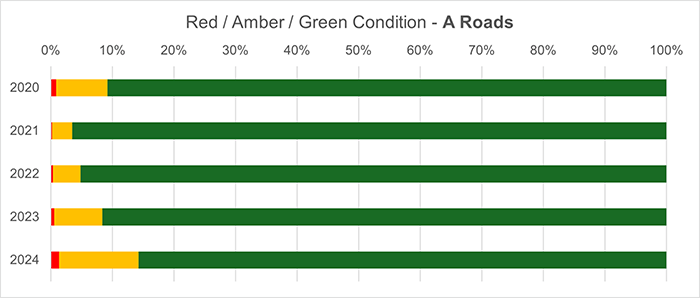
Over the past five years, the condition of Bexley’s road network has been recorded as follows:
| Year | Red | Amber | Green |
|---|---|---|---|
| 2020 | 0.86% | 8.38% | 90.76% |
| 2021 | 0.20% | 3.30% | 96.49% |
| 2022 | 0.38% | 4.48% | 95.14% |
| 2023 | 0.55% | 7.85% | 91.60% |
| 2024 | 1.36% | 12.91% | 85.73% |
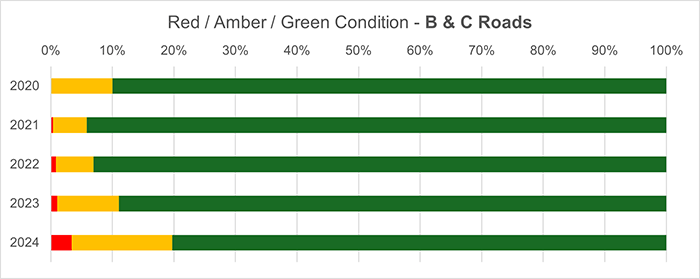
| Year | Red | Amber | Green |
|---|---|---|---|
| 2020 | 0.00% | 10.03% | 89.97% |
| 2021 | 0.39% | 5.47% | 94.14% |
| 2022 | 0.86% | 6.09% | 93.05% |
| 2023 | 1.04% | 10.00% | 88.97% |
| 2024 | 3.38% | 16.37% | 80.25% |
| Year | % |
|---|---|
| 2020 | 2.31% |
| 2021 | 3.17% |
| 2022 | 3.72% |
| 2023 | 6.92% |
| 2024 | 12.10% |
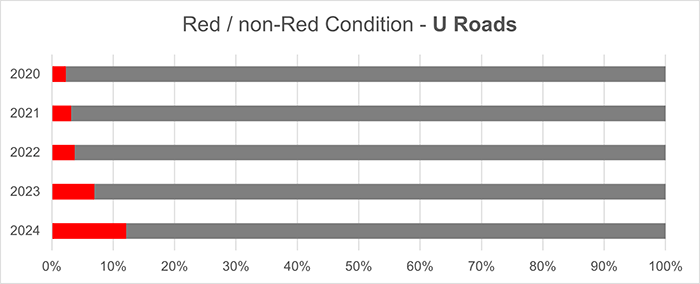
It can be seen that the percentage of Bexley’s network that fell within the Red condition category, and so should be considered for maintenance, commonly scored below 1%, representing less that 5km / 4 miles of road that may have needed repairs. The increased levels for 2023 and 2024 is attributed in part to the legacy impacts of the severe weather of December 2022, where small defects formed and have slowly deteriorated with weather and use.
Additional information on condition
Many of Bexley’s residential roads are constructed using concrete slabs. These consist of large concrete panels, typically 8 to 10 metres in length, which form the structural base of the road. Most of these roads are overlaid with a thin layer of asphalt, approximately 15 to 25mm thick. This asphalt layer improves vehicle grip and reduces tyre noise, giving the appearance of a fully asphalted surface, even though the underlying structure is concrete.
The concrete slabs include expansion joints, which allow the slabs to expand and contract in response to seasonal temperature changes. These joints, along with the natural flexing of the slabs under traffic (often referred to as “see-saw” movement), can cause cracking in the asphalt above. These cracks, known as reflective cracking, occur at regular intervals and are a normal characteristic of this type of construction. While they may be visible to road users and may generate some additional traffic noise, they do not indicate structural failure of the road or its surface.
In some cases, sections of the thin asphalt surface may break away, revealing the lighter-coloured concrete beneath. These patches are usually between 15 to 25mm in depth and, as such, fall below the Council’s defined thresholds for maintenance intervention. Their appearance does not mean the road is unsafe or that immediate repairs are required.